Bahariya Oasis is the gateway to the White Desert, and worth a night of its own
Bahariya Oasis is the gateway to the White Desert, and worth a night of its own
Bahariya Oasis is a depression of date palms, hot springs and small villages in Egypt's Western Desert, about 230 miles (370 km) southwest of Cairo and four to five hours by road. Most people come for the Black Desert and the chalk sculptures of the White Desert beyond it, where you sleep under the Milky Way. The oasis itself holds the Valley of the Golden Mummies, the painted tomb of Bannentiu, the only temple in Egypt built for Alexander the Great, and springs hot enough for a January evening soak. Go between October and April, give it at least two days and one night, and travel with a local operator in a proper 4x4. Explora Egipto runs it from your Cairo hotel.
Where Bahariya is and why it is called the gateway
Bahariya is the northernmost of the four big oases that curve through Egypt's Western Desert, ahead of Farafra, Dakhla and Kharga. It fills an oval depression about 60 miles (95 km) long, walled by escarpments, with the main town of Bawiti near the center.
Travelers know the name because of geography. The paved road from Cairo ends at Bawiti, and the road south from Bawiti passes, in order, the Black Desert, Crystal Mountain, the Agabat valley and the White Desert National Park. There is no other practical way in, so every White Desert trip starts, refuels and often sleeps in Bahariya.
Most itineraries treat the oasis as a gas station; it deserves half a day. If you are weighing the oases, Siwa is bigger and a destination in itself, Fayoum is the easy day trip from Cairo, and Bahariya is the one you pick when the White Desert is the goal.
The White Desert, the landscape you actually come for
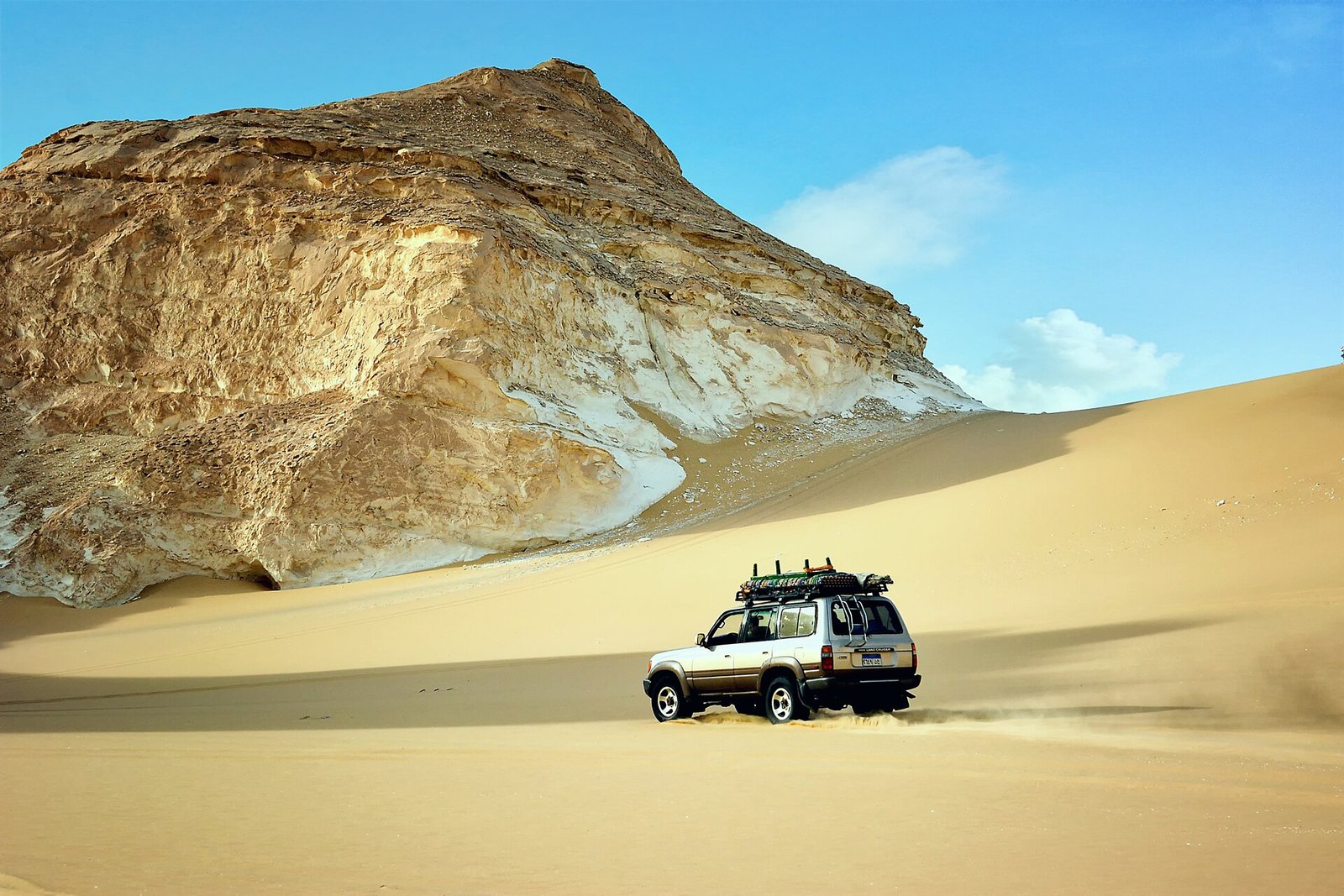
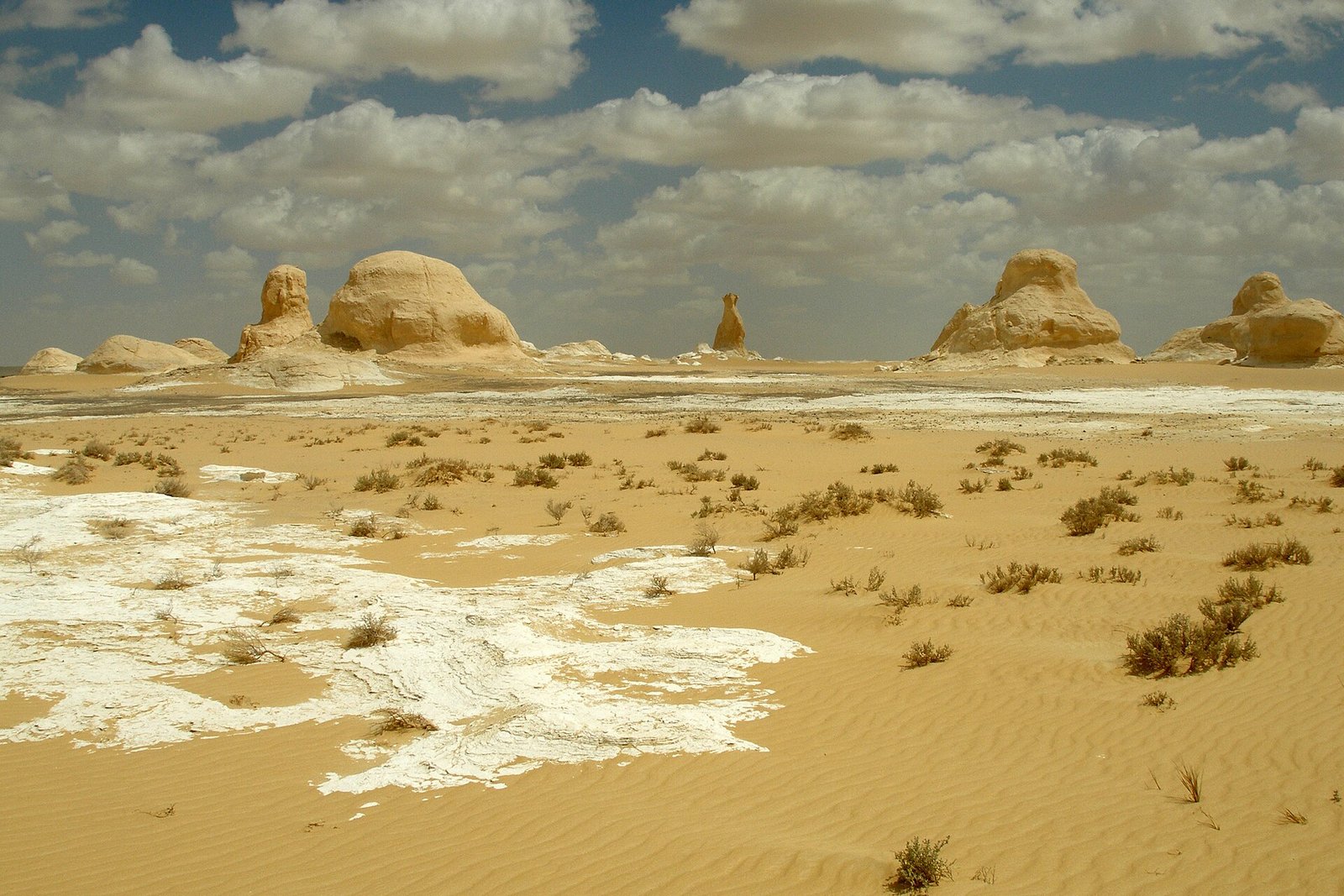
About 110 miles (180 km) south of Bawiti, the desert floor turns white. Wind has carved soft chalk into thousands of freestanding shapes, some the size of a car, some four stories tall: mushrooms on thin stalks, a chicken under a tree, a sphinx. In late afternoon the plain looks like a sculpture park abandoned by giants.
Your driver leaves the road and threads between the formations to a sheltered spot. Rugs and mattresses go down, a windbreak goes up, and dinner is cooked over a wood fire. There is no light pollution at all, so the Milky Way is visible to the naked eye, and fennec foxes come to sniff at the dishes.
The formations, the camp routine, the park rules and the photography are all in our White Desert guide. This page keeps to the oasis side and how the two fit together.
The Black Desert, Crystal Mountain and the English Mountain
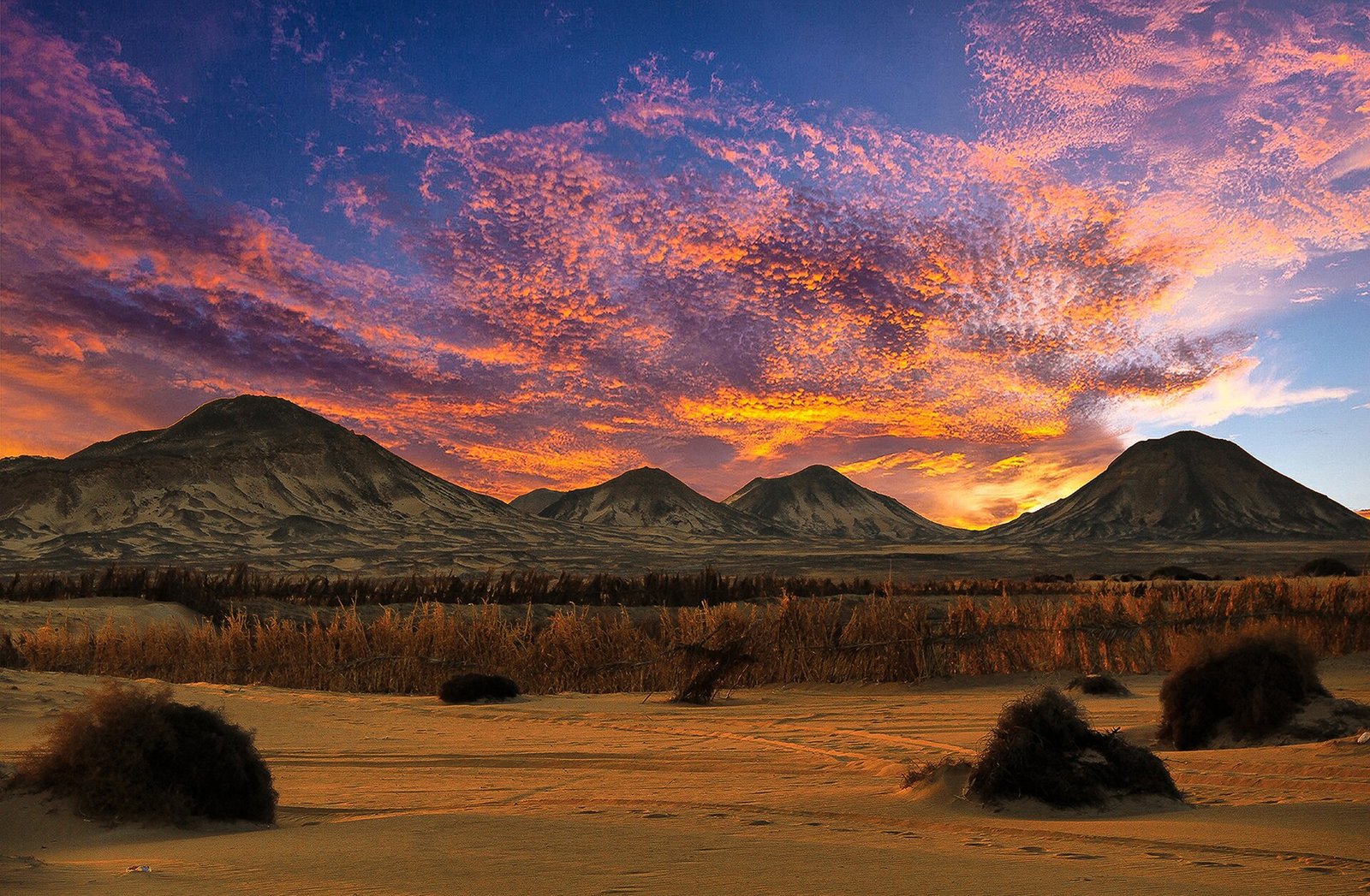
Before the chalk comes the basalt. About 30 miles (50 km) south of Bawiti the road enters the Black Desert, a plain of cone-shaped hills each capped with dark volcanic rock that has crumbled down the slopes and blackened the sand. You climb one of the taller cones in ten minutes for a view of hundreds of identical black hills fading to the horizon.
Farther south, beside the road, is Crystal Mountain, a low ridge of calcite and quartz that catches the sun. It is a fifteen-minute stop, and the rule is look, photograph, take nothing.
The English Mountain belongs to the oasis, not the road south. Gebel al Ingleez is a flat-topped hill outside Bawiti where a British officer, Captain Williams, kept a lookout post in the First World War to watch for Senussi raiders from Libya. The walls still stand, and the reason to climb is the sunset view: the whole depression below, palm groves against black hills. Nearby Gebel Dist is where Spinosaurus bones were found in 1911.
The Valley of the Golden Mummies and the museum in Bawiti
In 1996 a guard's donkey stumbled on the edge of a hole a few miles from Bawiti. Under it was a Greco-Roman cemetery, announced in 1999, with estimates running to several thousand burials, and the press named it the Valley of the Golden Mummies because so many of the dead wore gilded cartonnage masks and chest plates.
What makes the find interesting is who these people were. Not royalty: the wealthy families of a provincial oasis that grew rich exporting wine and dates to the Nile valley. Their burials mix Egyptian gods and funerary scenes with faces painted in the Greek portrait style, curled hair and all.
You cannot walk the cemetery; most of it was reburied for protection and the site is closed. What you can do is visit the small museum in Bawiti where a selection of the mummies lies in a plain, quiet gallery, a ten-minute visit that stays with you far longer. Your guide checks the opening arrangements the day before, since the museum keeps oasis hours.
The tomb of Bannentiu and the temple of Alexander the Great
Bahariya was rich long before the Greeks arrived, and the proof is a cluster of painted tombs on the ridge of Qarat Qasr Salim in Bawiti. The finest is the tomb of Bannentiu, a wealthy merchant of the 26th Dynasty, around the sixth century BC. You climb down a shaft into a pillared hall and a burial chamber painted floor to ceiling: the sun god in his boat, Anubis attending the mummy, Thoth and Horus, and Bannentiu himself among the gods. The colors are strong because sand sealed the tomb for two and a half thousand years.
Then there is the temple. At Qasr el Megysbah, on the edge of the palm groves near the village of El Qasr, stand the sandstone remains of a small temple that carried the cartouche of Alexander the Great. Tradition holds that he passed through Bahariya on his way to the oracle of Amun at Siwa in 331 BC, and this is the only temple in Egypt known to be dedicated to him. What survives is low walls and a sanctuary; go for the idea rather than the architecture.
The hot springs, and which one to pick
Bahariya's water comes up warm. Several springs are hot enough that a soak after a dusty day is the best hour of the trip. The water is mineral and slightly sulfurous, typically around 104 to 113 F (40 to 45 C), and the pools are simple concrete tanks under the open sky rather than spa resorts.
- Bir Sigam. About 4 miles (7 km) east of Bawiti on the Cairo road, the hottest of the easy ones and the usual first stop when you arrive from the city.
- Bir al Ghaba. Roughly 9 miles (15 km) northeast of town inside a grove of eucalyptus trees, quieter, best at sunset and after dark when the stars are out.
- Bir al Mattar. Closer to Bawiti, a cooler pool used by local families, better for a warm midday than a winter night.
Bring a swimsuit and a towel because there is rarely anything to rent, and women feel more comfortable in a t-shirt over the swimsuit when local families are present. There are no changing rooms; a car door and a towel do the job. In winter, get in at dusk when the air is cold and the water is hot.
Bawiti town and the date gardens
Bawiti is a low, dusty town of one and two story houses, a main street with tea shops and a market that comes alive in the morning. It is not pretty the way Siwa is, but it is where you eat, meet your Bedouin driver and understand how the oasis works. Give it an hour on foot rather than driving through.
The gardens are the real town. Behind the houses, canals fed by the springs run through groves of date palms with apricot, olive and citrus trees planted beneath them, three crops on one plot in the old oasis manner. In October the harvest is drying on rooftops and roadside mats. Ask for the half-hour walk through the groves to the neighboring village of El Qasr; it passes the ancient spring of Ain Bishmu, a warm stream cut into the rock and used since Roman times.
Bawiti runs on its own clock, and an afternoon in a garden with tea is the part of the trip people describe afterward.
The drive from Cairo, hour by hour
There is no train and no scheduled flight to Bahariya. The road leaves Cairo through 6th of October City and runs southwest for about 230 miles (370 km). Count on four and a half to five hours with one stop.
- Hour one. Clearing the city. Leave at six or seven in the morning and the day is relaxed instead of rushed.
- Hours two and three. Gravel plain, then dunes. A rest house roughly halfway has restrooms and tea, your only planned stop.
- Hour four. Mesas and black hills. Ask for the viewpoint above the depression; the palm groves appear as a dark green stain in the middle of nothing.
- Hour five. The road drops into the oasis. Most itineraries stop at Bir Sigam hot spring, then lunch in Bawiti, then a change to the 4x4.
Bring your passport, because there are police checkpoints on the highway and inside the depression. Do not attempt it in a rental car: beyond Bawiti is sand track with no cell coverage, and the park only admits registered operators.
One night or two: the honest comparison
Because the drive eats most of two days, a day trip is a punishment. The real choice is one night or two, and it depends on whether you want the White Desert alone or the oasis as well.
| Format | What you see | Who it suits | What you give up |
|---|---|---|---|
| 2 days, 1 night | Drive, Bir Sigam spring, Black Desert, Crystal Mountain, Agabat, White Desert camp, sunrise, back to Cairo by evening | Tight schedules where the desert night matters most | The museum, Bannentiu, the Alexander temple and the English Mountain sunset are skipped or rushed |
| 3 days, 2 nights | Day one: drive, spring, museum, Bannentiu, Alexander temple, English Mountain sunset, Bawiti lodge. Day two: Black Desert, Crystal Mountain, White Desert camp. Day three: sunrise, Bir al Ghaba soak, return | Families, photographers, anyone who wants the oasis as well as the desert | One more day from your Cairo or Nile schedule |
Our recommendation, having run both, is the second. The night in a Bawiti lodge means a garden, a hot spring and a real bed, and it lets you see the oasis before the desert. Two nights camped is the third option, for people who do not need a shower. If a Nile cruise follows, we drive you back to Cairo and put you on the morning flight to Luxor or Aswan; the guide to domestic flights in Egypt explains that connection.
Seasons: what the desert feels like month by month
The desert has one real season and one you avoid. October through April is the window. Inside it the days are pleasant and the nights run from cool to cold, and the difference between a good camp and a miserable one is whether you packed for the drop after sunset.
| Months | Daytime | Night at camp | Notes |
|---|---|---|---|
| October and November | 77 to 90 F (25 to 32 C) | 50 to 60 F (10 to 16 C) | The best balance. Date harvest in the oasis; nights need a fleece, not a parka |
| December to February | 64 to 72 F (18 to 22 C) | 34 to 45 F (1 to 7 C), sometimes lower | Clearest skies of the year. Wool hat, gloves and a down jacket for the evening |
| March and April | 75 to 88 F (24 to 31 C) | 50 to 60 F (10 to 16 C) | Pleasant, but khamsin season; a sandstorm day can wipe out the desert leg |
| May to September | 100 to 113 F (38 to 45 C) | 75 to 85 F (24 to 29 C) | Not recommended. Midday is dangerous in the open; the Red Sea is the better summer answer |
The rest of the country runs on a different calendar; the best time to visit Egypt guide covers it region by region. If the White Desert is on your list, let it decide your dates.
What to bring for the oasis and the camp
The camp provides mattresses, thick blankets, a windbreak, the fire, all meals, water and tea, and a sleeping bag on request. Everything else is on you. Our general Egypt packing guide covers the rest of the trip; this is the desert supplement.
- Layers for the night. A fleece, a windproof jacket, a wool hat and light gloves from November to March.
- A headlamp. Not a phone flashlight; you need both hands free at camp.
- Closed shoes. Sneakers or light hikers for the Black Desert climb and the chalk; sandals for the spring.
- Swimsuit and a small towel. For the hot springs, with a t-shirt over the swimsuit for women when locals are around.
- Sun kit. Sunscreen, sunglasses, a brimmed hat and a scarf for dust. The White Desert reflects light like snow.
- Wet wipes, hand sanitizer and a power bank. There is no running water and nothing charges at camp.
- Passport and small bills for tips. Checkpoints want the passport; the driver and the cook earn the tip by breakfast.
Leave the drone at home unless you hold the permit, and leave the fossil and the crystal where you found them.
How Explora Egipto runs the Bahariya trip
We are a local agency based in Egypt, and the Western Desert is a trip we run ourselves rather than resell. In practice that means:
- Pickup at your Cairo hotel in one of our own air-conditioned vehicles, early enough to clear the city. Your Explora guide stays with you the whole way.
- A Bedouin driver and 4x4 from Bawiti. Our drivers are from the oasis, hold the park permits, and know where the tracks are this month.
- The oasis sights included on the two-night format: museum, Bannentiu, the Alexander temple, the English Mountain and two hot springs, tickets handled by us.
- A private camp in the White Desert, set apart from other groups, with dinner over the fire and breakfast at sunrise.
- Return to Cairo with a spring stop and a connection to the rest of your trip, including the domestic flight to the Nile.
Bahariya sits naturally alongside our Cairo excursions and belongs on any list of unique experiences in Egypt. Send us your dates and how many nights you can spare, and we come back with the day-by-day plan. We do not publish prices; ask us for the quote.
Frequently asked questions
How far is Bahariya Oasis from Cairo?
About 230 miles (370 km) by the desert highway, which works out to four and a half to five hours with one rest stop. There is no train and no scheduled flight, so you go in a private vehicle from your Cairo hotel.
Can you visit the White Desert in one day from Cairo?
Technically, but you would spend twelve hours in a car to see the formations in flat midday light and miss the night. The shortest sensible format is two days and one night camped in the White Desert. Three days and two nights adds the oasis sights and is the version we recommend.
Is Bahariya Oasis safe for tourists?
The oasis and the road from Cairo are well traveled, with police checkpoints along the way. The real risks are environmental: summer heat, winter cold at night, and getting stuck off the track. All three are handled by going in the right season with a registered operator in a proper 4x4.
What is the Valley of the Golden Mummies?
A Greco-Roman cemetery near Bawiti, found in 1996 and announced in 1999, where thousands of the oasis's wealthy wine and date merchants were buried, many wearing gilded masks and chest plates. The site was reburied and is closed, but a selection of the mummies is displayed in a small museum in Bawiti.
Are the Bahariya hot springs worth it?
Yes, especially in winter. The water at Bir Sigam and Bir al Ghaba comes out around 104 to 113 F (40 to 45 C), in simple open tanks with a desert view. They are not spas: bring your own swimsuit and towel. A dusk soak in winter is the best half hour of the oasis.
Can Bahariya be combined with a Nile cruise?
Easily. The usual pattern is Cairo and the pyramids first, then two or three days in Bahariya and the White Desert, back to Cairo for a night, then a morning domestic flight to Luxor or Aswan to board the cruise. It also works in reverse. Tell us your total days and we fit it in.
Sleep under the Milky Way, then soak in a hot spring
Tell us your dates, how many nights you can spare and whether the Nile is part of the plan, and we come back with the day-by-day Bahariya and White Desert program, our own vehicles and guides throughout, and the quote in your inbox the same day.